Hospitals bring vulnerable patients, staff and complex care together. Patient movement, shared spaces and invasive procedures all create routes through which infections spread.

Myall et al.,

Containment is difficult because identification happens late. By the time an infection is confirmed, the patient may have moved between wards and exposed other patients who have since moved elsewhere. Some people may carry a pathogen without symptoms and remain absent from the hospital’s list of known cases.
Effective containment depends on seeing more of the developing picture. Hospitals need to detect infection risk early, reconstruct possible exposure, anticipate where risk may extend next and help clinical teams act while there is still time to prevent further harm.
Containment is the chain of decisions between the first signal of risk and the point at which transmission is interrupted.
Infections Often Start Before the Hospital Can See Them
Hospitals usually become aware of an infection through a clinical observation, suspected case or microbiology result. This signal is essential, but it only captures one point in a longer process.
A patient may carry a pathogen without symptoms. Testing is necessarily selective, and some results take time to confirm. Even when a case is identified quickly, its source and the extent of possible spread may remain unclear.
This is particularly important for antimicrobial-resistant organisms, which can colonise patients for long periods without causing obvious disease. Confirmed infections therefore provide only part of the information needed to understand risk across a hospital.
Healthcare-associated infections remain a daily threat to patient safety. A meta-analysis of 144 studies found that multifaceted infection prevention interventions were associated with reductions in healthcare-associated infection rates of between 35% and 55%. The risk of bias was high across most of the studies, so this figure is best treated as an estimate (Schreiber et al., 2018).
Recent surveillance shows why this remains urgent. Between April and September 2025, UKHSA recorded 86 new Candidozyma auris cases across 19 healthcare organisations. Most were colonisations. Two hospital outbreaks were already continuing when a further three were declared during the period (UK Health Security Agency, 2025).
Across the EU, carbapenem-resistant Klebsiella pneumoniae bloodstream infections have increased in 23 member states. ECDC has called for admission screening, coordinated control between hospitals and near-real-time whole-genome sequencing to identify outbreaks and transmission patterns (European Centre for Disease Prevention and Control, 2025).
Hand hygiene, environmental cleaning, appropriate device care, screening, isolation and antimicrobial stewardship remain fundamental. Better intelligence can help hospitals apply these measures to the right patients sooner.
Patient Movement Creates Transmission Pathways
This phenomenon has shaped my work for several years.
During our research at Imperial College London, we examined whether routinely collected bed-allocation records could reconstruct how patients were connected across a hospital. We represented the hospital as a network that changed as patients moved between rooms, wards and buildings.
We combined these contact patterns with clinical and hospital-level information to predict a patient’s risk of hospital-onset COVID-19 during the following seven days. The study included more than 51,000 inpatients in a London NHS hospital group. We validated the models using more than 40,000 patients in Geneva and a later cohort of more than 43,000 patients in London (Myall et al., 2022).
The full model achieved an AUROC of 0.89. A model using only contact-network information achieved 0.88, compared with 0.64 for a model using patient clinical variables alone (Myall et al., 2022).
These results showed that infection risk was shaped by the patient’s wider environment as well as their individual clinical characteristics. Two patients with similar clinical profiles could experience very different exposure because of where they stayed, who occupied those spaces and how they moved through the hospital.
A patient’s connection to the wider network of known infections was also more informative than direct infectious contacts alone. Conventional contact tracing remains essential, but longer and less obvious chains can contain additional information about how risk develops.
Recent research has extended this principle beyond COVID-19. In a large US health system, the time-weighted prevalence of an organism among ward co-occupants was consistently associated with hospital acquisition of the same organism. This relationship was found across drug-susceptible and drug-resistant pathogens (Sagers et al., 2026). The study shows an association and should not be interpreted as proof of individual transmission.
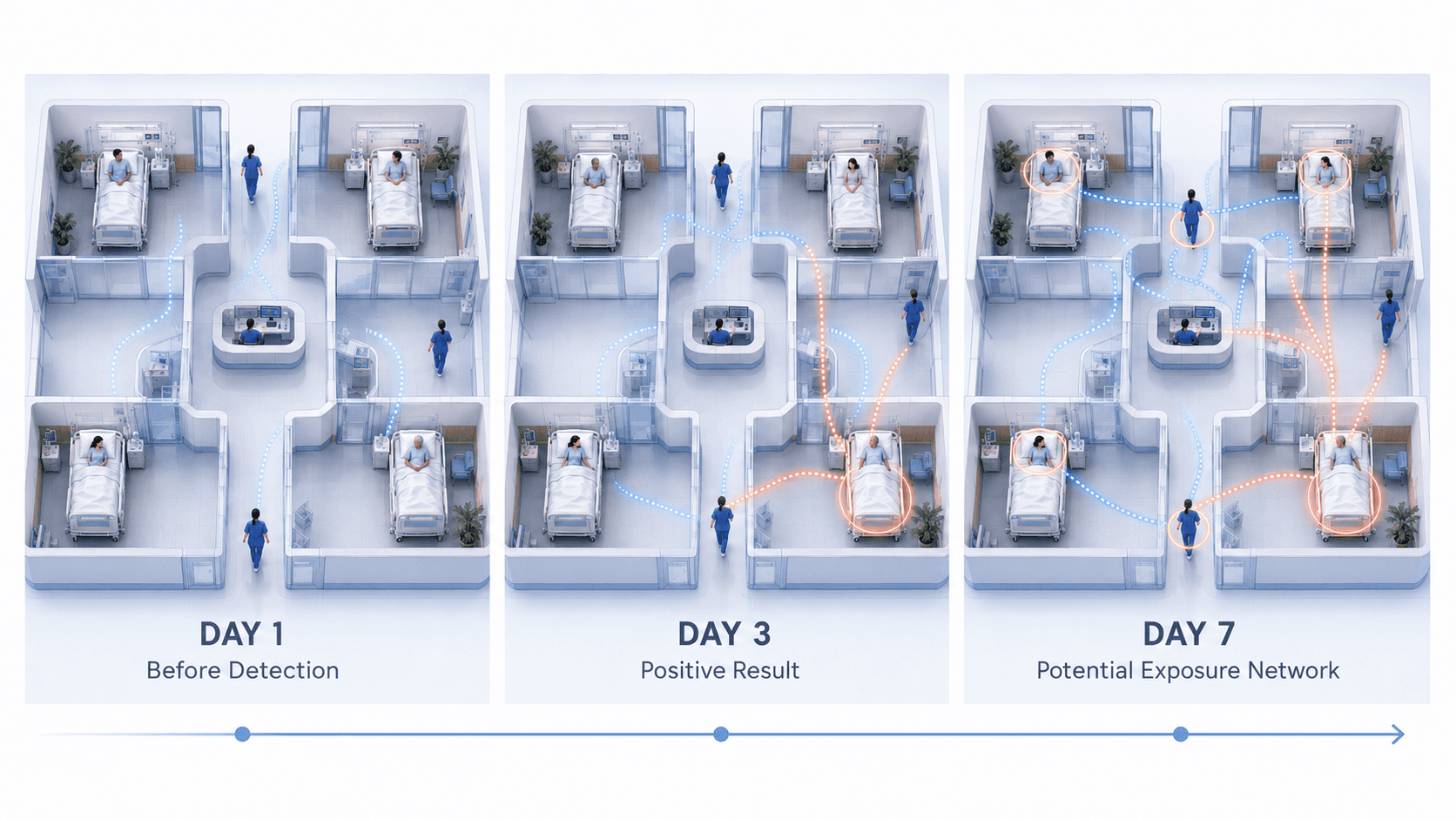
Infection Containment as Four Connected Steps
1. Detect the Signal
The first task is recognising that something may be changing. The signal could be a new positive result, an unusual increase in infections on a ward, several related cases across different locations or a patient whose risk is rising before symptoms appear.
Hospitals often hold the relevant information across microbiology systems, electronic patient records, bed-management data and manual IPC lists. Reviewing these sources separately or only at fixed intervals can delay recognition of the first signal.
An 82-hospital cluster-randomised trial tested whether automated outbreak alerts could reduce the number of additional cases. There was no significant reduction across the full study period. A post hoc analysis found a 64.1% reduction before the COVID-19 pandemic, although this effect was not seen during the pandemic (Baker et al., 2024). Earlier detection still depends on sufficient staff capacity and a clear response process.
2. Reconstruct the Context
A positive result needs a history. Clinical teams need to know where the patient has been, who shared those spaces and whether related cases have appeared elsewhere.
This work is still frequently manual. An Infection Prevention and Control (IPC) professional may need to move between systems, check dates and ward locations, then build a contact list line by line. The workload increases during an outbreak when time is most limited.
A digital infection-control system evaluated across three hospital sites reduced the time required for routine IPC tasks by an average of 74.9%, with savings of up to 81.5% for one task. The evaluation also identified usability problems and delays in system queries (Biermann et al., 2025).
The result shows the practical value of connecting movement and laboratory data. It also shows that time savings only matter when a system is usable and fits the team’s existing work.
Genomic surveillance can add another layer. At one US hospital, weekly whole-genome sequencing identified 172 outbreak clusters over two years. Following targeted interventions, 95.6% of outbreaks showed no further transmission along the identified route. The estimated infections prevented and cost savings were modelled, so the findings provide promising operational evidence (Sundermann et al., 2026).
3. Look Beyond Known Cases
Confirmed cases show where an organism has been detected. Asymptomatic carriers and untested patients can leave important gaps in the picture.
Recent research combined electronic health records, clinical cultures, patient movement and genomic data to infer possible undetected carriers of carbapenem-resistant Klebsiella pneumoniae. Adding these sources improved identification of carriers, while simulations suggested that inference-guided isolation could reduce transmission more effectively than simpler rules based on length of stay or contact tracing alone (Pei et al., 2025).
These findings are promising, but an elevated score should prompt review rather than automatic isolation. The evidence can help IPC teams decide where targeted testing or closer investigation may be justified.
4. Support Proportionate Action
Information becomes useful when it supports a clinical decision.
Depending on the pathogen, patient and setting, the next action may include:
Reviewing a patient’s record.
Prioritising targeted screening.
Applying or changing appropriate precautions.
Identifying and monitoring exposed contacts.
Cohorting patients or staff.
Strengthening cleaning in a particular environment.
Escalating a possible cluster for epidemiological or genomic investigation.
Every intervention uses staff time and limited hospital capacity. Poorly targeted action can also affect patients through unnecessary testing, isolation or disruption to care.
A useful system should therefore explain why a patient or cluster has been highlighted. It should allow clinical review and support a response proportionate to the available evidence.
Earlier Information Creates Time to Act
The central patient-safety test is whether an infection-intelligence system helps a clinical team make a better decision early enough to change what happens next.
The system should help teams identify possible clusters earlier, find contacts faster and prioritise the patients who most need review. It should also help them act without creating unnecessary disruption for everyone else.
This principle grew from our research and continues to shape our work at NEX. Hospitals already generate many of the signals needed to understand infection risk. The remaining challenge is to connect those signals into a timely and clinically useful picture, supported by appropriate safety controls and human judgement.
Skilled IPC teams, sound clinical practice and sufficient capacity remain central to containment. Better information allows their work to begin earlier.
In IPC, that earlier action can be the difference between one affected patient and many.