Across four hospitals at Imperial College Healthcare NHS Trust, conventional cluster criteria caught only about 1 in 5 of the patient pairs genomic analysis flagged as linked — and 2/3 of the clusters they did raise weren't genomically related. IPC teams may be missing real transmission while chasing connections that aren't there.
Rodgus et al.
Carbapenem-resistant Enterobacterales, or CRE, are a group of bacteria that have become resistant to carbapenems, antibiotics often reserved for serious infections when other treatments have failed. The World Health Organization places CRE in its critical-priority group of antibiotic-resistant pathogens. WHO Bacterial Priority Pathogens List 2024 →
Tracking how CRE spreads is not straightforward. Standard infection-cluster definitions generally look for cases involving the same bacterial species, on the same ward and within a short period. These definitions are practical, but they assume that transmission will occur between similar bacteria detected close together in time and place.
Two major genomic studies suggest that the real transmission picture is more complicated.
A recent retrospective study across four hospitals at Imperial College Healthcare NHS Trust found that standard cluster criteria missed most genomically supported links. WGS-Enabled Surveillance Improves Detection of Transmission Events Within a Large Tertiary Care Hospital Trust in London →
A national study across Singapore’s six multidisciplinary public hospitals reached a similar conclusion: CPE can spread through bacterial strains, through mobile resistance plasmids, and across wards, species and hospitals. Whole genome sequencing reveals hidden transmission of carbapenemase-producing Enterobacterales →
What does genomics add?
Genomics means analysing the DNA of an organism. For hospital outbreak investigation, whole-genome sequencing allows teams to compare bacterial isolates at a much finer level than their species name or antibiotic-resistance result alone.
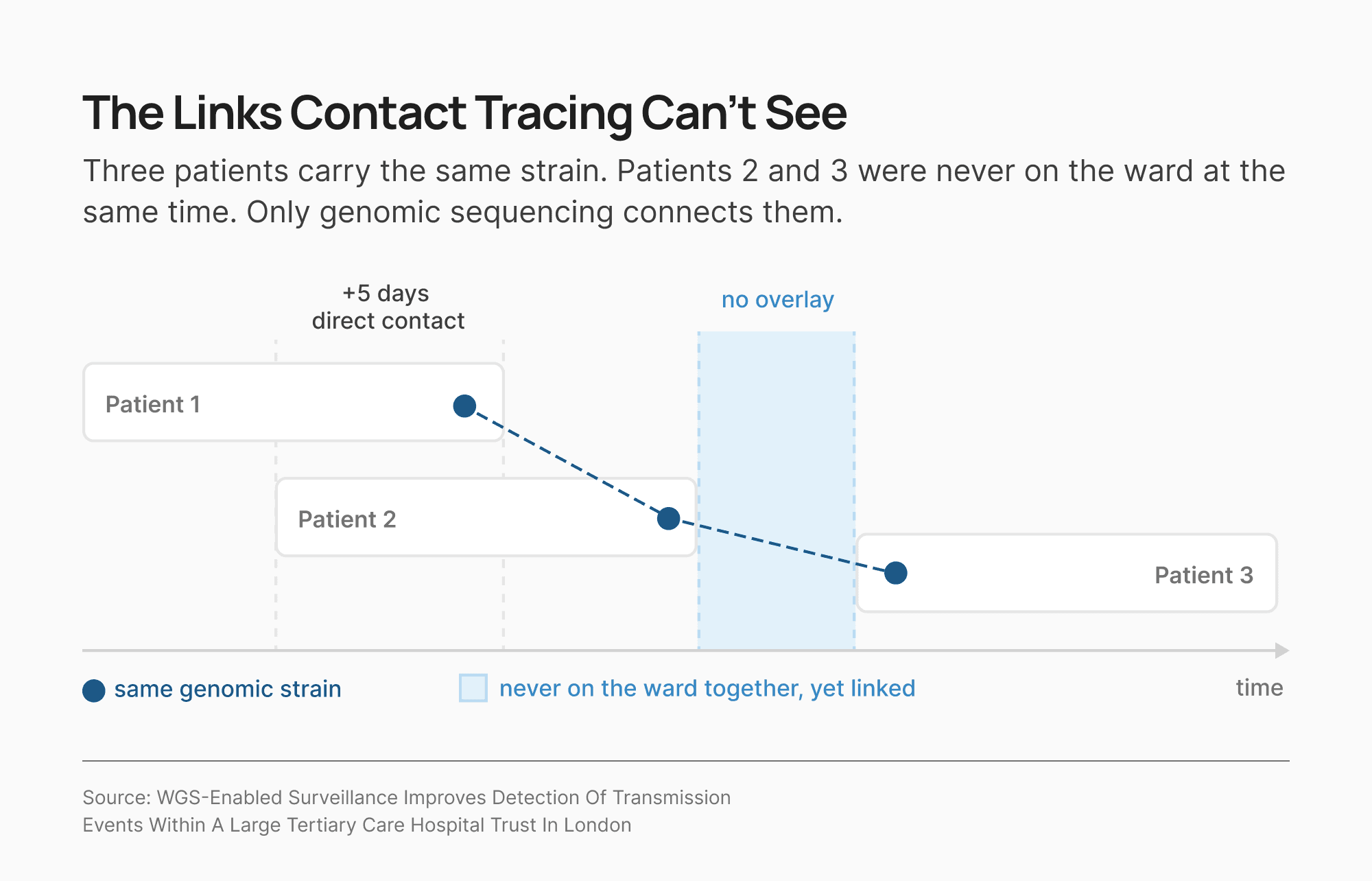
Two patients may both carry CRE, but genomics may show that the bacterial strains are unrelated. Conversely, two patients with no obvious ward overlap (or even with different bacterial species) may carry closely related resistance elements.
Genomics does not automatically prove that one patient infected another. It provides another layer of evidence for deciding whether cases are likely to belong to the same transmission network.
The limits of a standard cluster definition
The conventional definition evaluated in the Imperial College London led study looked for cases involving the same bacterial species, on the same ward, with samples collected within seven days and at least one case acquired after admission.
That is a sensible way to identify possible clusters using routinely available data. But it measures proximity, rather than biological relatedness.
Across the two datasets in the study, the conventional criteria identified only 24 of 117 genomically supported patient pairs and a sensitivity of 20.5%.
The problem also ran in the opposite direction. Of the 72 pairs flagged by the conventional criteria, only 24 were supported by the genomic analysis.
Taken together, the findings expose an uncomfortable gap: IPC teams may be missing important transmission networks while spending valuable time investigating groups of cases that appear connected but may not represent the spread of the same bacterial strain or resistance element.
Blind spot one: transmission takes time to appear
Transmission networks do not necessarily become visible within seven days.
Among same-species, same-ward pairs missed by the conventional definition, the mean gap between sample collections was 25 days in one dataset and 47 days in the other.
A fixed window can therefore close before the wider pattern becomes apparent. Patients may belong to the same transmission network but never meet the operational definition required to trigger an investigation.
Blind spot two: transmission crosses hospital boundaries
Genomically related isolates were also found in patients cared for on different wards and, in some cases, in different hospital buildings.
Patients may be connected through transfers, diagnostic areas, procedures, equipment, healthcare workers or environmental reservoirs without appearing on the same ward at the same time.
Transmission follows patient pathways and hospital ecosystems—not necessarily the administrative boundaries used to organise surveillance.
The wider evidence from Singapore
A large Singapore study shows why this distinction matters beyond a single hospital group Whole genome sequencing reveals hidden transmission of carbapenemase-producing Enterobacterales →
Researchers analysed 1,215 CPE isolates from 779 acquisition patients over 4.7 years. Among those patients, 42% met the study’s criteria for putative clonal transmission and 44.8% for putative plasmid-mediated transmission.
Fourteen of the 16 plasmid-mediated clusters involved more than one bacterial species. Fourteen also extended across more than one hospital.
The study found that direct, ward-linked clonal transmission declined after infection-prevention measures were strengthened. Plasmid-mediated transmission did not show the same decline.
The authors concluded that plasmid-mediated transmission accounted for around half of CPE dissemination and that persistent, undetected reservoirs continued to evade conventional infection-prevention measures.
The implication is not that existing IPC measures do not work. It is that measures primarily designed to prevent direct transmission from known carriers may address only one part of the transmission system.
Ruling links in and ruling them out
The operational value of genomics lies in both directions.
Ruling a link in matters when related cases fall outside a standard time window, occur across different locations or involve different species carrying a related resistance plasmid. Without genomic evidence, these cases may never trigger a wider investigation.
Ruling a link out matters because patients carrying the same resistant species, on the same ward and at around the same time, are not necessarily part of the same transmission chain.
Investigating a suspected cluster can require patient-movement reviews, contact tracing, wider screening, environmental sampling and additional control measures. Genomics may help teams focus that effort where the biological evidence supports a connection.
The economic evidence is still developing. A systematic review of nine economic analyses found that all supported whole-genome sequencing as a surveillance tool, but also highlighted substantial variation between studies and the need for more real-world effectiveness data. A systematic review of economic evaluations of whole-genome sequencing for the surveillance of bacterial pathogens →
What genomics cannot tell us on its own
Genomic relatedness does not prove direct patient-to-patient transmission.
Closely related isolates may be connected through an unsampled patient, a healthcare environment, equipment or another reservoir. Genomics can show that bacteria—or their plasmids—are related, but it cannot reconstruct every step of the transmission pathway without epidemiological context.
The Imperial analysis was also retrospective. It did not test whether genomic results could be generated, interpreted and delivered quickly enough to change live IPC decisions.
That is the next practical question.
Prospective programmes have shown that routine whole-genome sequencing can be introduced into clinical laboratories and used to identify clusters and support targeted IPC interventions. Clinical Implementation of Routine Whole-genome Sequencing for Hospital Infection Control of Multi-drug Resistant Pathogens →
The challenge is turning sequencing into information that reaches IPC teams at the right time, in a form they can interpret and act upon.
A clearer view of transmission
Standard infection-cluster definitions ask whether cases occurred close together.
Genomics asks whether the bacteria—or the mobile resistance elements they carry—are closely related.
Neither is sufficient alone.
Epidemiological information provides the context: where patients were, when they were there and how they may have been connected. Genomics provides evidence about whether the bacteria or plasmids support that suspected connection.
Used together, they can reveal links that would otherwise remain hidden, rule out cases that do not belong in the same cluster, and distinguish the spread of a bacterial clone from the movement of resistance between different bacteria.
That is the case for incorporating genomics into how hospital transmission is investigated—not as a replacement for IPC expertise, but as a way of making more of the transmission network visible.
Over the rest of this series, we will look more closely at plasmid-mediated spread, how raw sequencing data becomes actionable information, whether genomics can justify its operational cost, and what implementing it in routine practice would require.
————————————————————————————————————————
The Imperial research discussed in this article is currently available as a preprint and has not yet been peer reviewed.